
June 26, 2026 | Structural Change and the Labour Market
Employment growth in Germany from 2017 to 2024: What drives employment in an ageing society?

Despite its ageing population, Germany’s labour market has continued to expand in recent years. Employment has risen further even as the working-age population ages and large cohorts gradually exit the labour market. At the same time, labour- and skills-shortages have become more acute across many sectors. Previous research, such as by Christian Dustmann and colleagues from 2014 and Sabine Klinger and colleagues from 2019, shows that Germany’s strong employment performance since the mid-2000s was driven by labour-market reforms, rising participation amongst women and older workers, and substantial immigration inflows. More recently, demographic headwinds have intensified, raising concerns about the sustainability of employment growth in the medium term ⎼ for example from the European Central Bank in 2018 and the Bundesbank in 2023.
The role of migration
Recent evidence highlights that the improved labour-market integration of migrants has become an increasingly important driver of employment growth. In Germany, the employment rates of refugees and other migrants rise markedly with their duration of stay ⎼ increasingly converging towards the population average. This indicates that immigration contributes to employment growth not only through population inflows, but also through rising labour-market integration over time, as Herbert Brücker shows in his 2025 analysis. However, aggregate employment figures alone provide limited insight into the underlying mechanisms at work here. Employment growth may result from an expanding working-age population, shifts in demographic composition, or changes in labour-market behaviour within specific population groups (see boxes “Data and methods” and “Defining four population groups”). Distinguishing between these drivers is essential in assessing the resilience of employment growth in an ageing society and identifying effective policy responses to demographic change.
What are the drivers of this growth?
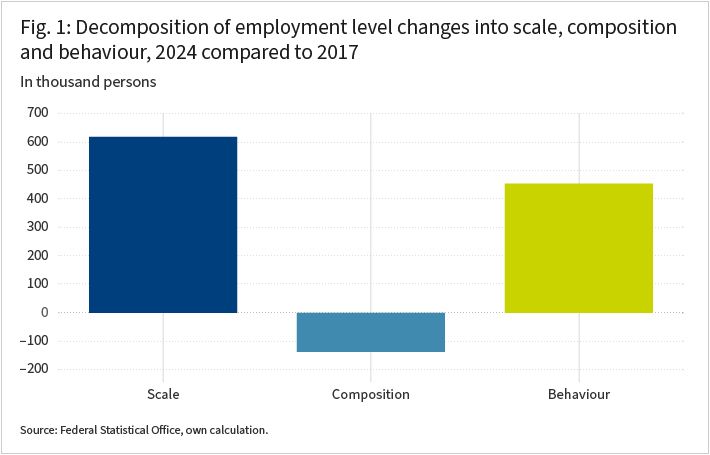
At the aggregate level, employment growth between 2017 and 2024 is largely explained by two forces. First, growth in the working-age population contributed positively to employment via the scale effect, reflecting immigration inflows and natural population changes. Second, rising employment rates within demographic groups ⎼ the behavioural effect ⎼ provided a substantial additional boost. In contrast, demographic composition exerted a negative effect, indicating that population ageing and structural shifts towards groups with lower average employment rates dampened employment growth.
Overall, Germany’s employment expansion during this period is primarily due to population growth and behavioural adjustments in the labour market. Figure 1 shows the overall contribution to change in employment according to scale, composition and behaviour (see box “Data and methods” for definitions). The rest of this article examines how these three mechanisms differ across nationality, migration background, gender and age groups.
Net employment growth driven by migration background
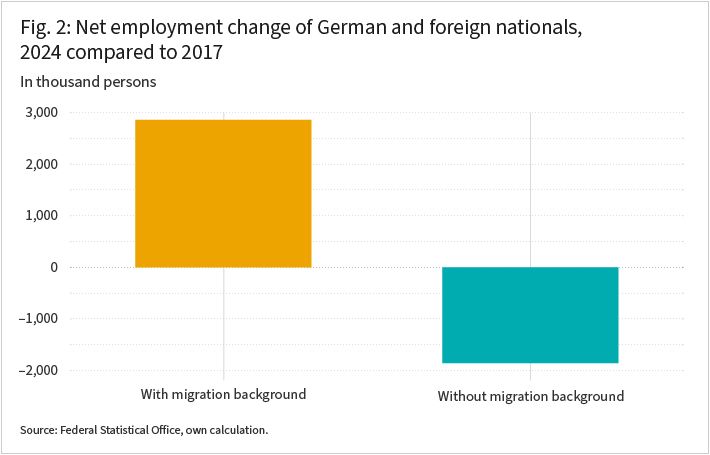
Figure 2 shows the net change in employment by migration background since 2017. Employment growth over this period is almost entirely attributed to rising employment amongst people with a migration background. While employment among people with a migration background has increased by nearly 2.9 million, employment among those without a migration background has declined by approximately 1.9 million. This divergence is largely driven by demographic factors. The number of people without a migration background of working age decreased during the period of analysis primarily due to population ageing, whereas immigration expanded the working-age population amongst people with a migration background. Employment growth amongst people with a migration background more than offsets the demographic-related decline among those without a migration background. The following analysis uses gender and age to identify the mechanisms underlying employment growth within and across population groups in more detail.
Employment growth for women
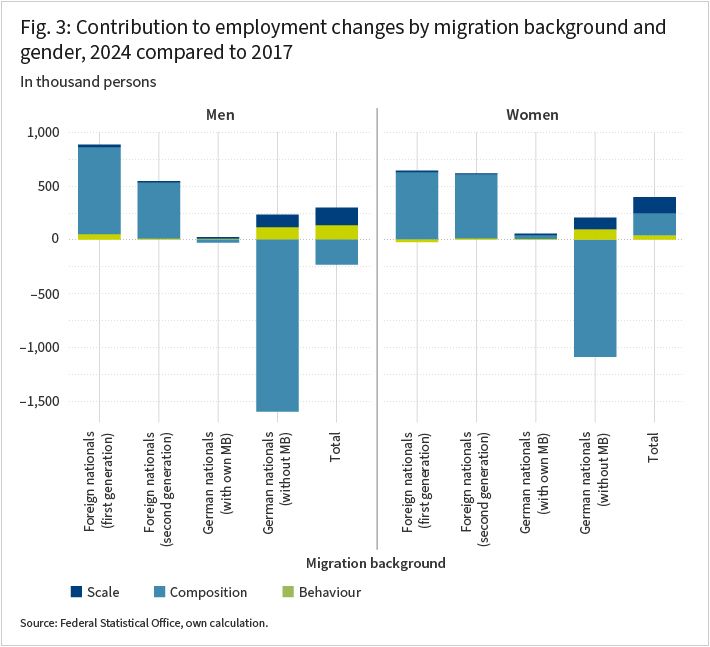
Disaggregating the results by migration background and gender reveals pronounced differences across population groups (Figure 3). Employment growth amongst foreign nationals (first- and second-generation) contributed strongly and positively for both men and women, driven by both population growth and rising employment rates. In contrast, German nationals without a migration background ⎼ particularly men ⎼ exerted substantial downward pressure on employment growth due to their adverse demographic composition.
Figure 3 illustrates that a positive net contribution can arise even when one component is negative, as scale, composition and behavioural effects may offset each other within groups. Amongst women, employment growth is observed across all migration-background groups. However, the underlying drivers differ markedly. While behavioural effects contribute positively for some groups, such as for female German nationals without a migration background, employment growth amongst female foreign nationals, especially in the first generation, is driven primarily by population growth and age composition, with behavioural effects playing a more limited or mixed role.
Age structure is also decisive for labour-market participation
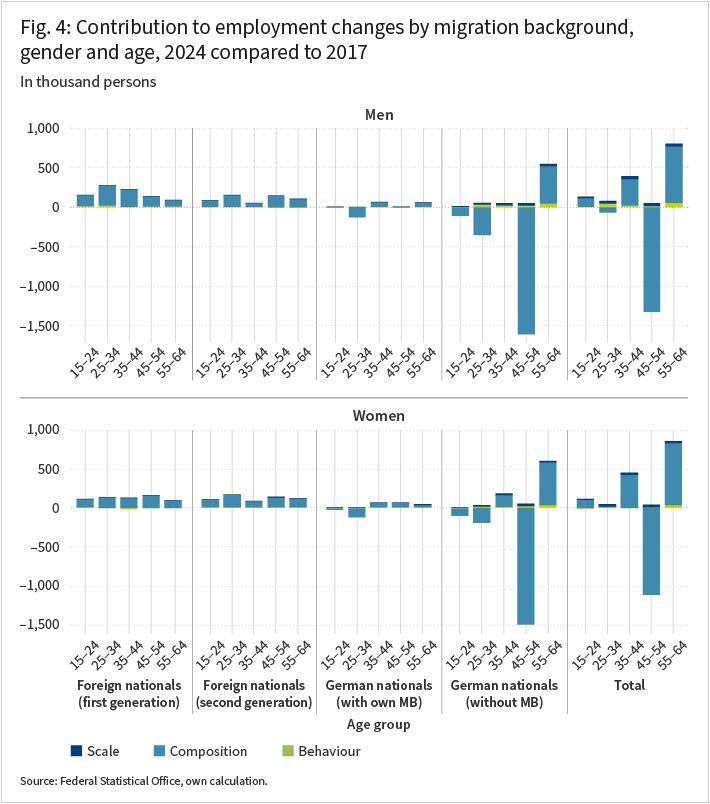
A further differentiation by age highlights that positive employment contributions are concentrated in the core working-age groups (roughly ages 25-54) ⎼ and particularly amongst persons with a migration background (first- and second-generation foreign nationals). This reflects both their comparatively younger age structure and improvements in their labour-market integration. At the same time, sizeable negative contributions emerge for older German nationals without a migration background, driven primarily by shrinking cohort sizes and population ageing. Across many age groups, behavioural effects remain positive, indicating broad-based increases in employment rates rather than changes confined to specific cohorts. Figure 4 complements Figure 3 by showing that the positive contributions of migrants are not only gender-specific but also concentrated in younger and prime-age cohorts.
Conclusion ⎼ continued efforts are necessary
Employment growth in Germany between 2017 and 2024 was driven primarily by population growth and rising employment rates within demographic groups, while demographic ageing had already started to exert a dampening effect on aggregate employment. The decomposition analysis described here shows that recent employment gains were achieved despite, not because of, the demographic structure ⎼ a pattern that is likely to become more pronounced as population-ageing progresses. In decomposition terms, positive scale and behavioural effects more than compensated for adverse compositional shifts.
Thus, labour-market resilience increasingly depends on behavioural and structural adjustments. Rising participation amongst women and older workers, together with the improved labour-market integration of immigrants, has played a central role in offsetting adverse demographic trends. Without these developments, employment growth would have been substantially weaker. From a policy perspective, sustaining employment growth in an ageing society requires continued efforts to support labour-market participation. Policies that promote lifelong learning, improve work–family compatibility, facilitate migrant integration, and encourage longer working lives will only increase in importance. Immigration remains a key channel for stabilising labour supply, but its contribution to employment growth depends not only on the size of the inflows (scale) but crucially also on the successful labour-market integration of migrants, which increases their employment rate over time.
Complementary descriptive analysis by the Statistics of the Federal Employment Agency further shows that these developments differ considerably across occupations, sectors and regions, with foreign nationals increasingly contributing to employment growth in labour shortage occupations, service sectors and eastern German labour markets.
Literature
Bossler, M., Popp, M. (2023). Arbeitsmarktanspannung aus beruflicher und regionaler Sicht: Die steigende Knappheit an Arbeitskräften bremst das Beschäftigungswachstum. IAB-Kurzbericht 12/2023.
Bundesbank (2023). Labour supply, demographic change and potential output in Germany. Deutsche Bundesbank Monthly Report.
Brücker, H. (2025). Drivers of employment growth: An overview of the integration of migrants into the German labour market. IAB-Forum, 31 July 2025.
Das Gupta, P. (1993). Standardization and Decomposition of Rates: A User’s Manual. U.S. Bureau of the Census.
Dustmann, C., Fitzenberger, B., Schönberg, U., & Spitz-Oener, A. (2014). From sick man of Europe to economic superstar: Germany’s resurgent economy. Journal of Economic Perspectives, 28(1), 167–188.
European Central Bank (2018). Labour supply and employment growth. Economic Bulletin, Issue 1.
Kitagawa, E. M. (1955). Components of a difference between two rates. Journal of the American Statistical Association, 50(272), 1168–1194.
Klinger, S., & Weber, E. (2019). GDP–employment decoupling in Germany. Structural Change and Economic Dynamics, 52, 82–98.
Statistik der Bundesagentur für Arbeit (2026). Berichte: Blickpunkt Arbeitsmarkt – Zunehmende Bedeutung der Zuwanderung für die Beschäftigungsentwicklung, Nürnberg, Juni 2026.
DOI: 10.48720/IAB.FOO.20260626.01
Bild: Robert Kneschke / stock.adobe.com
This publication is licensed under Creative Commons Attribution-ShareAlike 4.0 International (CC BY-SA 4.0): https://creativecommons.org/licenses/by-sa/4.0/deed.de
 Read more
August 5, 2026 | Social Inequality, Joblessness and Social Inclusion
Why confidence matters: The hidden barrier for women in STEM
Despite strong educational achievements, women in Germany remain underrepresented in Science, Technology, Engineering, and Mathematics (STEM) careers – an imbalance that fuels the gender pay gap, as ...read more
 Read more
May 4, 2026 | Interviews
The gender AI gap: “AI is becoming a key resource – but men and women are not using it in the same way”
The rapid spread of AI in the workplace is creating a new divide: the gender AI gap. A recent study by the IAB conducted in collaboration with Initiative D21 shows that women use AI considerably less ...read more
 Read more
Artificial intelligence is changing the world of work right now – and those who use it often have clear advantages in the job. However, recent data show that women resort to AI significantly less ...read more