
January 15, 2026 | Labour Market Policy
Minimum wage and job reallocation: The hidden role of financial constraints

In 2015, a nationwide minimum hourly wage of 8.50 Euro was introduced in Germany. Since then, research has consistently shown that the policy raised wages for low earners and reduced income inequality. As Christian Dustmann and colleagues demonstrated in a study from 2022, the effects on overall employment are limited. Instead, the reform led to reallocation of workers from less productive, lower-paying firms to more productive, higher-paying ones. However, not all firms were equally able to adjust to these changes. For instance, in a study from 2024, Hamzeh Arabzadeh and colleagues found that the decrease in wage inequality was much stronger for firms which faced difficulties in obtaining external financial resources. Since this brings further payroll pressure to the firm, it has important implications for how these firms adjust their workforce.
In this article, employment changes in firms before and after the minimum-wage introduction 2015 are analysed. Firms are separated into four groups according to their exposure to the minimum wage and to financial constraints (see Info box “Four categories of firms”):
- Minimum-wage unaffected, without financial constraints: minimum-wage bite below 5 percent and low leverage (leverage ratio below 50 %).
- Minimum-wage unaffected, with financial constraints: minimum-wage bite below 5 percent but high leverage (leverage ratio above 50 %).
- Minimum-wage affected, without financial constraints: minimum-wage bite above 15 percent and low leverage.
- Minimum-wage affected, with financial constraints: minimum-wage bite above 15 percent and high leverage.
Employment growth after the introduction of the minimum wage is dependent on the firm’s financial constraints
When looking closer at the different categories of firms, a heterogeneous picture is revealed. The results show a clear pattern: financially unconstrained, unaffected firms — that is, those with strong balance sheets and limited exposure to the minimum wage — experienced the strongest employment growth after the minimum wage was introduced. By contrast, employment declined strongly in firms which were minimum wage affected and financially constrained. Table 1 illustrates employment growth for all four groups, based on full-time equivalent (FTE) employment—a measure that captures total labour input across different contract types :
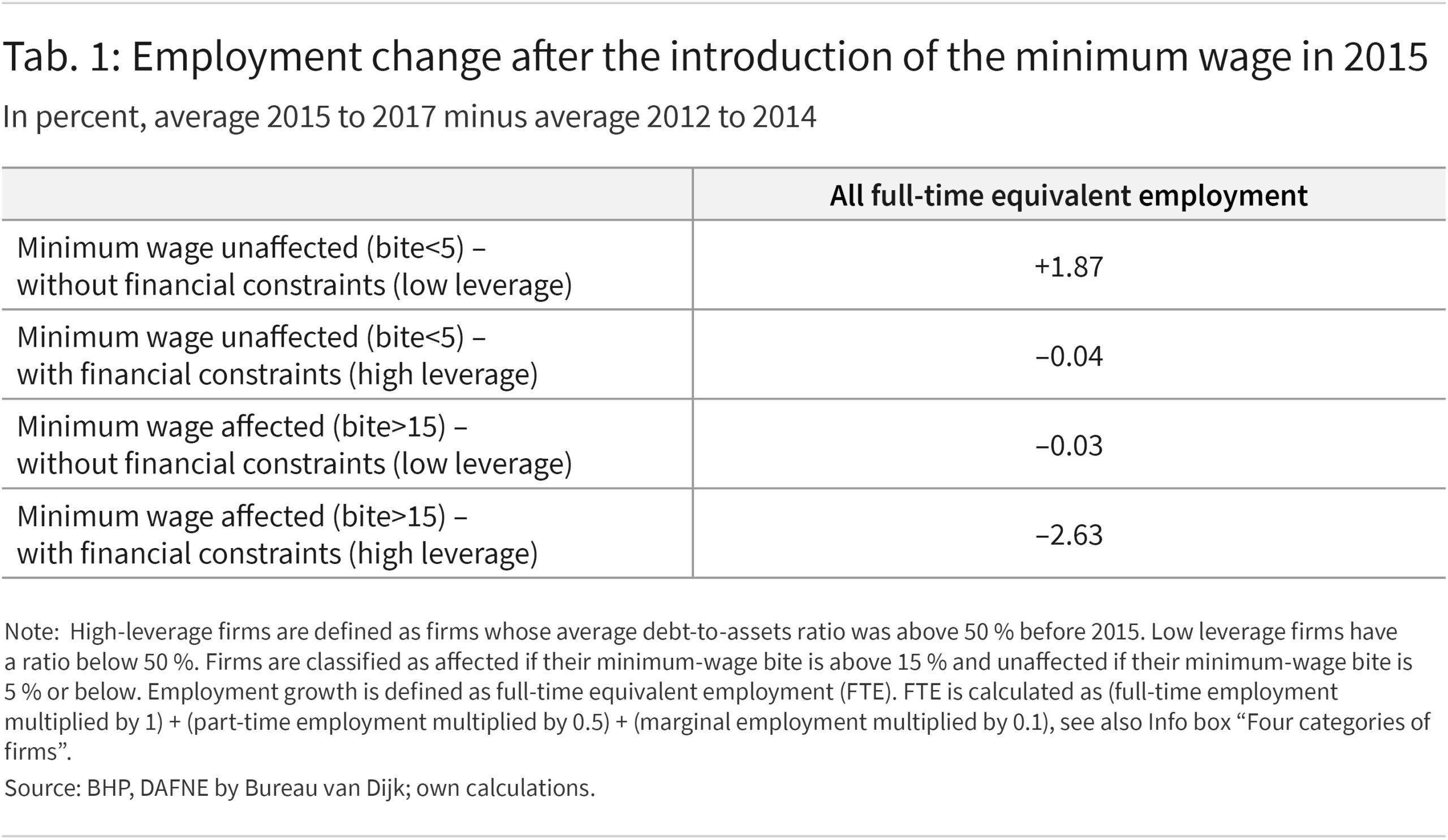
The employment in firms with low debt ratios and low minimum wage bite (minimum wage unaffected, without financial constraints firms) increased almost by 2 percent after the introduction of the minimum wage. This is the only group that experienced employment growth, which suggests that employment reallocated to these firms after the introduction of minimum wage. Employment in firms with low minimum wage bite but high financial constraints, or firms with no financial constraints but high minimum wage bite stayed the same. The sharper contrast appears when taking financially constrained firms into account: Employment stayed the same for those firms that were unaffected by the minimum wage with financial constraints. This underscores that financial constraints limit firms’ growth capacity. Finally, for the firms which were affected by the minimum wage, and which were financially constrained, employment strongly declined by 2.6 percent. The combination of higher payroll expenses due to the introduction of minimum wage and financial constraints exert an additional limit on firms’ growth capacity which brought this strong decline in employment. One concern is that financial constraints are related to a firm's size, growth potential and productivity, which in turn may affect how the minimum wage can be absorbed by the firm.
However, an analysis by Almut Balleer and others (2025) that controls for firm observables including size, growth and productivity before the introduction of minimum wage reveals that the effects of financial constraints on employment remain strong. These results suggest that while the introduction of the minimum wage may not have caused large changes in total employment, it nevertheless created strong reallocation effects. Financial flexibility plays a crucial role in enabling firms to adapt to wage increases without cutting jobs.
Looking deeper: Where does the employment change come from?
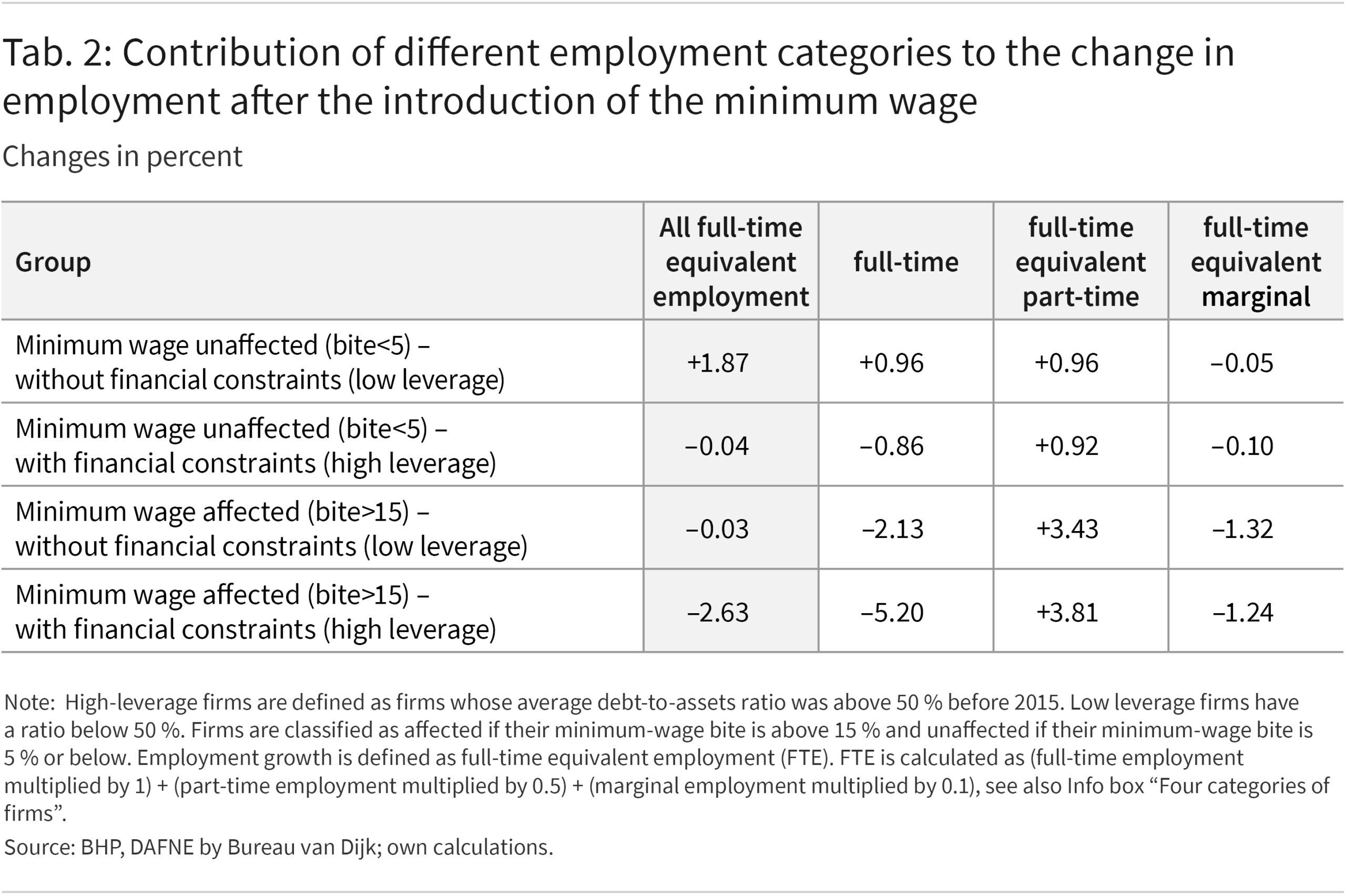
Table 2 shows how different employment types contributed to the change in total full-time equivalent employment for each group. Interestingly, full-time employment only increased in financially unconstrained firms that were not affected by the minimum wage. Here, employment gains are evident for both full-time and part-time employment. In contrast, total full-time employment declined by 0.9 percent in minimum wage unaffected but financially constrained firms. This decline is, however, compensated by a similar increase in part-time employment.
In minimum wage affected but financially unconstrained firms, full-time employment declined as well, but there was strong employment growth as an increase in part-time employment more than compensates for this decline. This suggests that firms respond to higher wage-costs by reallocating labour from full-time to part-time rather than reducing overall employment. Moreover, the minimum wage caused a strong decline in marginal employment for affected firms. Part of the movement from marginal to part-time employment may be mechanical as some workers move above the mini-job limit due to the minimum wage. The decline of full-time employment in affected and financially constrained firms is strikingly high: it decreased by 5.2 percent relative to total employment, and part-time gains were not enough to offset these losses.
These findings suggest that the minimum wage exerts moderate losses in full-time employment, but increases part-time employment and drives a decline in marginal employment. Financial constraints strongly reinforce this pattern for full-time employment, whereas the effects of the minimum wage are similar for part-time and marginal employment, irrespective of whether the firm is financially constrained or not. This finding is in line with the interpretation that financial constraints incline firms to cut costs for more expensive employees, i.e. full-time workers. Financial constraints result in a reallocation of full-time employees from affected-constrained firms to unaffected-unconstrained firms.
Conclusion
The German minimum wage raised wages without reducing aggregate employment, but not all firms responded equally. Financially constrained firms – especially those strongly affected by the minimum wage – reduced employment, particularly amongst full-time workers. Financially unconstrained firms were more resilient, often growing even in the face of wage increases. This highlights the role which access to financial resources plays when firms adjust to wage policy changes without cutting jobs.
Literature
Arabzadeh, Hamzeh; Balleer, Almut.; Gehrke, Britta; Taskin, Ahmet Ali (2024): Minimum wages, wage dispersion and financial constraints in firms. European Economic Review, No. 163, Art. 104678.
Balleer, Almut; Gehrke, Britta; Taskin, Ahmet Ali (2025). Mindestlohn als Stresstest: Finanzielle Spielräume. Wirtschaftsdienst, Vol. 105, No. 10/2025, pp. 758-762.
Bossler, Mario; Schank, Thorsten (2023): Wage inequality in Germany after the minimum wage introduction. Journal of Labor Economics, Vol. 41, No. 3/2023, pp. 813-857.
Dustmann, Christian; Lindner, Attila; Schönberg, Uta; Umkehrer, Matthias; vom Berge, Philipp (2022): Reallocation effects of the minimum wage. The Quarterly Journal of Economics, Vol. 137, No. 1, pp. 267-328.
Giroud, Xavier; Mueller, Holger M. (2017): Firm leverage, consumer demand, and employment losses during the great recession. The Quarterly Journal of Economics Vol. 132, No. 1/2017, pp. 271-316.
picture: Andreas Karelias / stock.adobe.com
Citation note
Taskin, Ahmet Ali; Gehrke, Britta (2026): Minimum wage and job reallocation: The hidden role of financial constraints, In: IAB-Forum January 15, 2026, https://forum-f.iabpro.de/en/minimum-wage-and-job-reallocation-the-hidden-role-of-financial-constraints/, Accessed: September 6, 2026
This publication is licensed under Creative Commons Attribution-ShareAlike 4.0 International (CC BY-SA 4.0): https://creativecommons.org/licenses/by-sa/4.0/deed.de
 Read more
When firms face lower investment costs, it not only encourages them to purchase new machinery and equipment but also helps secure and create jobs. An analysis of the German investment tax credit ...read more
 Read more
October 28, 2025 | Interviews
A Basic Income: simple idea, complex reality
Basic income is a simple idea on paper with regular, unconditional cash for everyone, but implementing it is anything but simple. In this interview, Professor David Green discusses findings from a ...read more
 Read more
July 31, 2025 | Labour Market Policy
Drivers of employment growth: An overview of the integration of migrants into the German labour market
In the public debate in Germany, it is often assumed that it is financially more attractive for migrants and refugees to remain on mean-tested benefits for unemployed people than to work. On the ...read more